





Content area
Full text
Abstract
The development of alternate catalyst systems with required conversion levels under milder experimental conditions in terms of pressure and temperature as compared to those employed for ammonia synthesis on iron-based catalysts is one of the prime objectives of research today. In this connection, ruthenium-based catalysts with suitable support and promoter have been examined extensively. The status of the development and perspectives are examined in this presentation.
Introduction
The reaction that has contributed to sustainability of living beings on earth, as well as for most of the developments in science including catalytic science, is ammonia synthesis, introduced in the initial years of the last century, even though this process was known earlier. Catalytic ammonia synthesis technology has been playing a crucial role in the development of the chemical industry in the last 110 years. Ammonia is used mainly as nitrogenous fertilizer and as a raw material for the production of many of inorganic compounds like nitric acid, ammonium salts, cyanide and organic compounds, such as amines, sulfanilamide and many others in addition to being an excellent refrigerant[ 1]. Ammonia has an important position in any economy since nearly 1 percent of total energy demand of the universe is utilized in this synthesis.
Historically, in the 19th century, ammonia was obtained from natural saltpeter or recovered from coal. In order to meet the increasing demand for nitrogenous fertilizers, a variety of methods were tried to fix nitrogen from air. From 1902 to 1913, three nitrogen-fixing processes were created, i.e., the electric arc process, calcium cyanamide process and catalytic ammonia synthesis technology.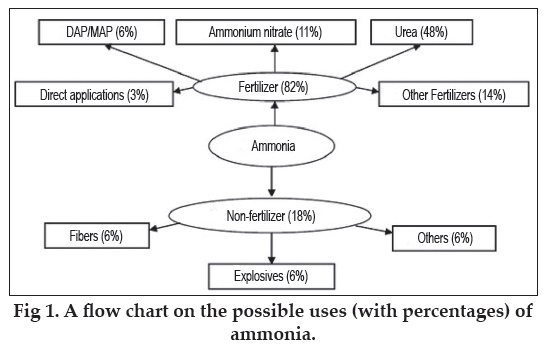
Catalytic ammonia synthesis from dinitrogen and hydrogen molecule was developed by Fritz Haber, and then Carl Bosch applied this process to industrial production of ammonia successfully in the early years of 20th century. The first ammonia plant was built for the production of 30 tons of ammonia per day in 1913 at Oppau, Germany. Up to 1934, this catalytic process became the dominant route for nitrogen fixation. Because of the extensive use of nitrogenous fertilizers, catalytic ammonia synthesis plays an important role in agriculture and other industries.
There are various aspects of ammonia synthesis like economically generating the synthesis gas and their purification and also other engineering aspects of the process [2]. In this presentation...