




Content area
Full text
A low-cost and time-effective solution for Quantum Safe Migration of legacy & Upcoming Communication Networks & Applications
Cryptography is used by security practitioners to protect anything that relies on electronic communication and data storage.
Cryptography uses computational hardness as a means to protect sensitive data. There are cryptographic problems that are difficult or impossible to solve using conventional computing.
Cryptographic algorithms can be broadly classified into two categories based on the keys used during the encryption and decryption processes:
* Symmetric/Secret Key Cryptography: In this scheme, encryption and decryption keys are the same and they should be known to only the communicating parties.
* Asymmetric/Public Key Cryptography: In this scheme, two keys are used i.e. public key (for encryption) and a private key (for decryption). Only a private key needs to be kept secret as it is used for decryption. (See article on QKD in same issue for more details).
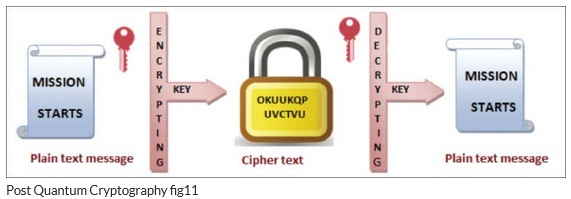
In most public communication networks, a combination of asymmetric as well as symmetric key cryptography schemes are used. An Asymmetric/ Public Key Cryptography scheme is used for key distribution purposes while the data flow is secured using a symmetric scheme because of its better performance in the encryption/decryption process.
Quantum Computing and Quantum Algorithms
Quantum Computing
Quantum computing is the exploitation of collective properties of quantum states, such as superposition and entanglement, to perform computation.
It is a new branch of computing in which the fundamental unit of storage is Qubits rather than bits in the conventional computer. A Qubit can store both 0 and 1 at the same time. Quantum computers perform calculations based on the probability of an object’s state before it is measured – instead of just 1s or 0s – which means they have the potential to process exponentially more data compared to classical computers. In short, we can say, Quantum computers can perform very rapid parallel computations as compared to classical computers.
Quantum Algorithms
There are two groundbreaking Quantum algorithms that have laid out a strong foundation for breaking today’s number theoretic-based public key cryptosystems.
* In 1994, Shor proposed a polynomial-time (efficient) algorithm for solving integer factorization and discrete logarithm problems. The algorithm relies on the existence of quantum computers, and hence this type of algorithm is called quantum...